Monday, August 6, 2012

YMCA (another view)


Beautiful tile work seen on the facade of the YMCA building, downtown.
Share

Labels: ,

Wednesday, August 1, 2012

Looking down


Vintage terrazzo flooring seen outside Wig Villa, Central Avenue.

Share

Labels:

Thursday, June 28, 2012

Alley view: 2012 or 1912?

Tuesday, April 17, 2012

Where's my bike?


It's probably in the basement of the Snell Building.
Share

Labels: ,

Saturday, March 31, 2012

Christ United Methodist Church

Christ Church, originally known as First Methodist Episcopal Church of St. Petersburg, opened its doors February 17, 1892 with twenty members on the corner of Central Avenue and 5th Street at a cost of $500. The first full time minister arrived in 1902. The building went from a 24 x 38 foot building (1892), to a "shell dash" church (1906) at its current location at 1st Avenue North and 5th Street, to a "buff brick" church seating 1,050 (1915), to its present sanctuary (1953), seating 1,704.

Share

Labels: ,

Monday, January 23, 2012

All bricked up


Out for a stroll one recent morning, I happened upon a downtown alleyway just north of 4th Avenue S that runs between two small, nearly-brand-new apartment buildings. The alleyway, like many old alleys in Downtown St Pete, was paved with bricks. And not just any bricks: noticeably, several different kinds of bricks, from several different Southern foundries. I found it interesting seeing some names I'd never heard of, being very used to the AUGUSTA BLOCK bricks so prominent in St Pete alleys.


Curious to find out more about the history of the quarries and their product, I snapped a few photos and decided to do a little 'brick research.'
WESTPORT PAVING BRICK CO., Baltimore, Md.
From WikiAnswers: Westport Paving & Brick was a Baltimore based manufacturer of bricks. The company was located in the Westport area of south Baltimore, an older industrial east coast city located in the state of Maryland.
The company was founded around 1905 by William L. Wise Sr. of Baltimore, Maryland.
At one time, Westport Paving & Brick was one of the larger manufcaturers of bricks in the DelMarVa area many of which were used in both the commercial as well as residential sectors.

So well regarded were these bricks, known as 'Baltimore Bricks' that many were exported to other municipalities for construction of government buildings, streets, alley ways and sidewalks. Often the bricks were used during shipping as the ballast itself. By the mid 1920s with more automobiles prevalent amongst the middle class, a more refined surface was needed to give drivers a smoother ride and the time of the brick street was at an end.

One place of note where the 'Baltimore Bricks' can be found in abundance is at the Ernest Hemingway house located in Key West, Florida. The bricks had initially been shipped via clipper ships to Key West in the 1910s. By the mid 1930s, the city council decided to upgrade their streets with the new easier to drive on concrete formulas so common at that time. Mr. Hemingway purchased the bricks from the city of Key West at the cost of one penny per brick. Hemingway purchased approximately 20,000 of these bricks which he used for the wall surrounding his property and also his walkways.

Westport Paving & Brick was still in business during World War II and appears to have disbanded around 1948.
COPELAND-INGLIS SHALE BRICK CO., Birmingham, AL
From the Society for Georgia Archeology: Copeland-Inglis shipped bricks across the Southeast. They were used in Chattanooga’s freight depot in the late 1800s. They also were used in Tampa, in the driveway of a 1891 building that was once a hotel, and is now a museum on the University of Tampa campus.

SOUTHERN CLAY MFG CO., Robbins, TN
From TN GenWeb Project: In 1902 The Tennessee Paving Brick Company sold its Robbins operation to the Southern Clay Manufacturing Company of Jersey City, New Jersey. This was the same year that the community of Robbins, Tennessee was granted a town charter. Southern Clay Manufacturing imported and applied mass production machinery and techniques to the clay products industry at Robbins. The Robbins plant then began to produce and sell SCM paving bricks, fire and chemical bricks, clay sewer pipe, various construction bricks, and square-2,6, and 9-sectioned telephone line conduit. The Robbins brickyard prospered until the late 1920s when macadam paved road construction replaced brick paving and when disastrous hurricanes in Florida ended a decade long building boom. This construction decline spelled hardship for the Robbins plant because much of its production was based on contracts with Florida developers. Shortly after this the Great Depression occurred and the Robbins plant suffered a slow decline in contracts as construction projects dwindled. Slowdowns and lay-offs occurred during this time including some years which saw the Robbins brick plant open for only a few months at a time. Attempts were made to save the Robbins plant by encouraging nearby communities to pave many of their local roads with SCM bricks, all to no avail. The last bricks produced at Robbins were made in 1937 and went to Alcoa, Tennessee.

GEORGIA VITRIFIED CLAY CO., Harlem, GA
From The Augusta Chronicle: Georgia Vitrified Brick and Clay Co. opened in 1902. The main part of the institution was at Campania, about two miles outside Harlem. One of the company's founding officers, Frank R. Clark, was instrumental in helping locate the first bank in Columbia County, at Harlem, in November 1905.

The company's kilns were used to produce sewer pipes, chimney liners, flues, tiles and other clay products. During its heyday, the enterprise rented small apartment homes in Belair to house many of its employees at Campania and its mines.

The company's legacies include bricks embossed with the "AUGUSTA BLOCK" trademark, manufactured and produced through the 1940s.

These bricks still can be found at some locations across the South. They are on some walkways near Riverwalk Augusta and Daniel Village, and some are embedded in highways throughout the vicinity. Old courthouse and cemetery yards in Georgia still yield the famed bricks that were processed at the ovens in Campania. Moreover, many also can be found in areas of Florida such as Tampa and St. Petersburg.

The company was sold in 1995 to an Indiana firm. Its facility at Campania has been used primarily as a distribution point.

MONARCH BRICK CO., Rockmart, GA
From The Georgia Department of Archives and History: The Monarch Brick Company was organized with the intention of producing slate and using the waste in brick manufacturing. By the time the plant was built in 1900, the demand for slate was declining rapidly, and the company never produced any slate. Monarch was soon reorganized, becoming the Rockmart Shale Brick and Slate Company. For about 20 years the plant manufactured a vitrified paving brick, using, in part, weathered slate or shale. The company closed its doors in the 1920s.

And this final informational tidbit, from the St Petersburg City Council:
Initially developed with a system of dirt roads, St. Petersburg started paving city streets with brick in 1903 when a bond issue was passed to pave Central Avenue from 2nd Street to 5th Street with brick. Between 1909 and 1913, $202,000 was allocated to improve city streets and expand brick paving into the surrounding residential neighborhoods and along Central Avenue to the western end of the city. By the end of the Florida land boom in 1926, St. Petersburg had over 300 miles of brick paved streets. With the development of new paving techniques during the late 1920s, brick paving declined in the city. In 1941, there were 339 miles of brick streets in the City. By 1960, this number dwindled to approximately 113 miles since many streets were
overlaid with asphalt. By 1992, approximately 93 miles of brick streets remained.

Final note: fabulous brick streets can be found in Roser Park, Park Street, and vitually all over the Old Northeast neighborhood as well as hundreds of alleyways - like the little one I stumbled upon - throughout Downtown.


Share

Labels: , , ,

Saturday, December 10, 2011

Sign of the times, part two


Scribbled on a power transformer, these messages reflect current social climate.
Share

Labels:

Thursday, December 8, 2011

Christmas with the Finest!

Seen outside a fine jewelry shop on Beach Drive North.

Share

Labels: ,

Sunday, December 4, 2011

Ruby's


Popular jazz watering hole located in Jannus Landing on 3rd Street, downtown.
Share

Labels:

Monday, November 28, 2011

Paradise Found

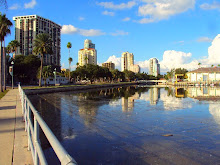
The view along Bayshore Drive facing north.

Share

Labels:

Friday, November 25, 2011

Park View Building

Floor entryway to the Park View Building on 4th Street North. The park it overlooks is Williams Park. This building has a fabulous old elevator, which we'll feature soon in a blog post.

Share

Labels:

Tuesday, November 22, 2011

Recumbent Nude on Beach Drive

This lovely lady surveys passersby on Beach Drive outside the restaurant Ceviche.

Share

Labels: ,

Tuesday, August 16, 2011

City Lights


Skyline view facing north, on a summer night.

Share

Labels: ,

Tuesday, July 26, 2011

Williams Park Vista


Facing north-northeast on a summer morning, the Williams Park bandshell figures prominently in the foreground.
Share

Labels:

Sunday, April 24, 2011

The state of the State Theatre


St. Petersburg's classic State Theatre looks to be in fine form on a busy Thursday evening.
Share

Labels: ,

Tuesday, March 1, 2011

The changed face of Central Avenue

Central Avenue. This main city thoroughfare bisects north and south St Petersburg. It begins at the water's edge of Tampa Bay, and ends, ceremoniously, at the entrance to the Treasure Island Causeway. Central Avenue is a chameleon, changing as it zips through several St Petersburg neighborhoods, beginning with Downtown, and winding up in Old Pasadena. Drive down its never changing straightness, and you'll see banks (plenty), churches (many, and of all denominations), fast food, antique shops, vets, family restaurants, tattoo parlors, lawyers, CPAs, doctors, a bus station, a police station, and gas stations (many).

Let's take a quick look, for now, at Central in the immediate Downtown area. It's easy to take for granted the buildings and parking lots that dot the street in the present day: but it is also interesting to discover what used to be in those same spots a few generations ago. It's not the same St. Petersburg, that much is certain - then, or now.

The tour begins at 333 Central. Triple-three will not be found on a map today; it is merely the Municipal Parking Garage; its ugly white stone edifice rising six stories above solid ground. In 1940, however, 333 Central was home to Dent and English Tailors, no doubt proffering handsome and now quite-coveted men's suits. There is an entry in the 1912 St. Petersburg City Directory for Dent & English, listed as "gents furnishings" (sic).

View Larger Map
Moving up a few doors, and on the same side of the street, was Shepard Co. at 353 Central. Also in its place is the same parking garage. Shepard touted themselves (in a 1925 edition of the Times) "Florida's Finest Shoe Store." They offered "ladies' fine domestic and imported bedroom slippers of felt satin...in shades to match your negligee" ! In Shepard's stead in the years to come, were the Johnson-Dehon shoe store (1930s), the Maas Shoe Store (a temporary spot to sell shoes whilst the famous department store underwent construction a few blocks away in 1947), and, eventually in the name of "progress," it was razed to make way for the parking garage (sometime in the early 1970s). With the advent of suburban shopping, folks were less interested in buying shoes at some old-timey independent shop than at the new air-conditioned stores in sprawling places like Tyrone Mall.

Crossing over Fourth Street and continuing on the same street side, is 415 Central. It's been that address at many points in time since at least 1909, when a Dr. Rouse, Physician and Surgeon, conducted his practice there. (Had you needed to telephone him in 1909 about a sick stomach, his exchange was simply '67.') Looking up, most folks nowadays might recognize 415 as the former home of a vintage dime store. The fabulously forties McCrory sign still hangs aloft the address, as tribute to the golden days of green-bench glory when snowbirds and residents rubbed shoulders in the aisles looking for swim suits, camera film, Kleenex and pencils. Four fifteen was, too, a Walgreen (minus the S) at one point in time. Now, it harbors several hip gifts shops and restaurants, whose patrons, mostly a youngish clientele, shop and dine blissfully unaware of the parcel's fabulous past as a storied, classic five and dime.

Strolling westward on Central by a few blocks, we come to a large parking lot on the south side of the street that was the former home of 720, a Western Union office during the 1920s, and later on in the Thirties, the St. Petersburg Gas Appliance Company. The Western Union, when there in 1927, told the Timesthat it was adding more telegraph lines in St Petersburg due to higher demand for sending telegrams. (Doesn't that sound quaint now? Telegrams!) Just a few doors down, and in the same now-parking lot, was 730, home to Lovett's Groceteria (and that makes me chuckle, thinking about Mrs. Lovett in Sweeney Todd.) At the height of the Depression, in 1933, weekend specials at Lovett's included two heads of lettuce for 15c; Del Monte coffee, 23c per pound; and cabbage, 3c per pound. Lovett's opened on Central in 1932, and was considered a "novel store," meaning the gimmick was something inherently familiar to us all now: self-service. An interesting fact is that Lovett's was franchised out by Winn and Lovett, better known in the south as Jacksonville-based Winn-Dixie. The store on Central, however, was seen as simply a locally operated extension of the W&L family. I'm unable to find any information as to when the Central Avenue Lovett's was closed down or razed, but apparently there were a few more franchises in St. Pete, including one at 551 Ninth Street N.

Crossing 8th Street but staying on the same side, we come to a quite-unattractive boxy Seventies building, which sits on land previously occupied by 842 Central - which had had a busy life as several businesses from the 1920s through the 1970s when the original building(s) were razed. Among some of the businesses at 842 were Madam Wilma, who offered "character readings;" Campbell Hardware; Harvey's Fix-It; Arthur L .Johns, Menswear; Joe Solomon, Menswear; and Frank Decker, antique dealer. The sporadic nature of the businesses leads me to believe there must have been an arcade at that address, housing all these diverse businesses who lapsed over one another from the Twenties through the Sixties. Under one roof, such as an arcade, these small, locally-owned businesses would have been able to flourish in synch, much like a modern day shopping mall.

Our final stop takes us to 1000 Central, to what is probably the happiest success story of all the addresses we've discussed. You will see an attractive, classic brick and mortar building housing Savannah's Cafe, a fairly recent newcomer to the downtown scene and purveyors of classic yet upscale Southern cuisine. Savannah's is housed in a former Studebaker auto dealership building, and most of the original architectural features have been preserved. Technically, the current address is 1113 Central, but as a former car lot, the property must have encompassed a block or even two. Fortunately, this classic 1920s building stands unhindered by the wrecking ball, and almost as originally intended, being used and enjoyed by St. Pete people almost 100 years later.
(Photo courtesy http://www.studebaker-info.org/)



Share

Labels: ,

Monday, February 21, 2011

Save the turtles


A sea turtle comes to life under an artist's hand at a recent sidewalk art show in downtown St Pete.
Share

Labels: , ,

Tuesday, October 19, 2010

Downtown View


View of downtown, facing southwest. Visible are the Detroit Hotel, Jannus Landing, and the Hotel Dennis, among others.
Share

Labels:

Friday, October 15, 2010

Moon over St Pete


October, 2010.
Share

Labels: ,

Saturday, September 18, 2010

Cafe Bohemia


Two scenes from Cafe Bohemia, inside and out. The cafe is an arts & music-centered gathering spot on Central Avenue near downtown that also serves food, beer & wine.
Share

Labels: